


 VI
VI

 BACK TO THE NEWS PAGE
On March 31, 2023, Vietnam Report Joint Stock Company officially announced the Top 10 Construction Companies in 2023.
This is the result of an independent study by Vietnam Report, built on scientific and objective principles to recognize and honor the key players of the construction industry who have been making every effort and achieving many accomplishments in providing products to customers, building an impressive image in the eyes of the public and investors, demonstrating strong resilience with stable financial capacity and good endurance when facing compounded difficulties from the decline in supply in the period before COVID-19, the consequences of the pandemic up to the Russia – Ukraine conflict, fluctuations in raw material prices, rising inflation and sharply increasing interest rates…
Enterprises were screened from the database of Vietnamese enterprises in Vietnam Report’s ranking studies in the construction industry with financial data updated to December 31, 2022, combined with the use of the Media Coding method (coding press data on media), surveys of the research subjects and related parties to provide the most comprehensive, objective and complete overall assessment of enterprises throughout the recent difficult period, highlighting the following names.
List 1: Top 10 Construction Contractors in 2023

List 2: Top 5 MEP Contractors in 2023

Looking back at the market’s self-filtering process in the construction industry over the past 5 years
Figure 1: Growth/decline rate of value added in the construction industry in the period 2011-2022

“Filtering” or “self-adjustment” are phrases that most clearly reflect the developments of the construction market over the past about 5 years after the strong growth period 2011-2015. In particular, in the early months of 2020, COVID-19 was like a “black swan” that disrupted all aspects of socio-economic life, pushing the world faster into a new economic cycle. Looking back at market developments in the past period, it can be divided into 3 stages corresponding to the process of responding to the pandemic as follows.
First, the pre-COVID-19 period. Having been developing very rapidly in 2017-2018, the real estate market in 2019 suddenly “slowed down” mainly due to legal factors. This led to a decline in supply in the construction industry, reflected in the significantly reduced number of approved projects. According to data from the Vietnam Real Estate Association, there were only 5 projects eligible for new implementation, approved in Hanoi in 2019. Vietnam Report’s survey conducted in February 2020 showed that 91.4% of construction contractors and MEP contractors considered the reduced number of approved projects as their biggest difficulty in 2019.
Second, the COVID-19 period. This period was associated with disruptions and instability due to the pandemic. Before the strong outbreak of the pandemic, many localities were forced to implement social distancing, leading to many projects having to stop construction or be delayed due to broken supply chains of materials and manpower. The most clearly visible economic losses were: costs of maintaining the apparatus, pandemic prevention costs, costs of mobilizing resources after distancing periods… 37.9% of enterprises participating in Vietnam Report’s survey conducted in February 2021 said that over 20% of their projects/contracts were delayed or had cost impacts due to COVID-19. This period also began to record the surge in construction material prices. The price index of raw materials, fuel and materials used in construction increased by 6.4% compared to the same period due to high demand for construction materials while supply chains had not yet fully recovered from disruptions since 2020. Because construction material costs account for about 65-70% of the estimated cost of construction works, rising construction material prices directly affected construction investment costs, the efficiency of many projects, and eroded profit margins of enterprises.
Some experts in the industry commented that the “price storm” swept away the remaining rare profits, pushing many enterprises into losses. According to data from the General Statistics Office, the growth rate of the entire industry in 2021 reached only 0.63% – a very low level compared to the average growth of 7.2% over the past 10 years.
Figure 2: Level of completion of planned targets of construction enterprises

Third, the post-COVID-19 period. After two years of stagnation due to the pandemic, the construction industry entered 2022 with many expectations for recovery. In early 2022, many construction enterprises recorded strong growth in the value of signed contracts (backlog) and positive civil construction demand after the distancing period. However, immediately afterward, consecutive headwinds affected the financial health of enterprises in the industry.
First was the Government’s implementation of a series of measures to filter the bond market and tighten credit for real estate, causing the real estate market to fall into a state of frozen liquidity. As they are in the same Real Estate – Construction – Construction Materials ecosystem, once investors’ capital flows are blocked, contractors’ cash inflows also slow down as outstanding unpaid debts from investors accumulate more and more. Meanwhile, contractors still have to strain to get through an increasingly harsh price storm.
According to sharing from leaders of some units in the industry, from the time of bidding to the time of construction estimation, material prices had increased sharply, even making it clear that it would be a loss before doing the work. Some units with stable financial capacity and good endurance could still continue to maintain and stand firm through the price storm, while others were forced to withdraw from bidding. According to Vietnam Report’s survey results, 86.7% of construction enterprises said total costs increased compared to the previous year, higher than the rate of cost increase in the 2020-2021 period (+44.6%). The rate of completing plans for revenue and profit both decreased, while the rate of not completing plans for revenue and profit was higher than the time a year earlier.
In the context of general difficulties of the whole economy, the growth rate of value added of the construction industry in 2022 reached 8.17%, although still lower than the growth rate in the pre-COVID-19 period but improved strongly compared to two years of market stagnation due to the pandemic, thereby contributing 0.59 percentage points to the growth rate of total value added of the whole economy.
The market filtering process, highlighting the pillars of the construction industry throughout the recent difficult period, is also truthfully reflected through the media lens. Vietnam Report’s media analysis results from February 2020 to now show that although business activities were somewhat quiet due to market fluctuations, media activities of enterprises in the industry were still very active; most contractors had a higher frequency of appearance on the media than in previous years. Hoa Binh and Coteccons were still the two contractors attracting the most media attention. Fecon and Newteccon were contractors with a fairly stable increase in frequency of appearance on the media. (Figure 3)
Figure 3: Outstanding contractors on the media

According to Vietnam Report, an enterprise is assessed as “effective” in terms of diversity of media image when its information coverage reaches 10/24 topic groups, and “outstandingly effective” if it reaches 15/24 topic groups. Media analysis results show that the proportion of enterprises achieving “effective” in the past year decreased significantly, reaching only 20.5% compared to 45.1% and 39.1% in the previous two years. Among them, Finance/Business results was the topic that attracted the most media attention with a rate of 21.9%, far exceeding the remaining topics such as Stocks and Image/PR/Scandals. This truthfully reflects that the top concern of the construction industry in a year with many fluctuations was the financial health and resilience of enterprises.
Figure 4: Proportion of coded information of construction enterprises by information sources on the media

The media analysis results of Vietnam Report indicate an encouraging signal that enterprises in the industry are increasingly active and more proactive in media activities. The proportion of news released by enterprises in the past year increased significantly compared to previous periods. (Figure 4).
Previous studies by Vietnam Report have pointed out that once an enterprise appears lacking proactiveness on the media and allows most information to be self-exploited by the press, it means that the enterprise has not had forecasts and response measures for unexpected media incidents that may occur, increasing the level of media risk. In the context of a market with many fluctuations, increasing one’s share of voice on the media is an effective solution to help enterprises maintain their image in the eyes of the public and investors.
Outlook for 2023: Proactively breaking through difficulties – Highlights from the infrastructure and industrial sectors
Most enterprises participating in the survey conducted by Vietnam Report in February 2023 appeared quite cautious about this year’s business outlook. According to the assessment of leaders of some large enterprises in the industry, 2023 is still a very difficult year for contractors because they are under very great financial pressure. Considering the industry value chain, when carrying out construction, construction contractors will receive cash flow from project investors: (1) Advance payment for contractors before starting project construction; (2) Payment according to project progress based on acceptance results of the completed volume.
However, in practice, general contractors often face the risk of cash flow deficits and must rely on credit capital sources for project construction due to three reasons. First, construction costs often have to be paid quite early. Second, payment cash flow from investors is often slow. Third, subcontractors/construction teams often have small scale and have difficulty accessing credit capital sources, thereby pushing the pressure of cash flow deficits and borrowing to general contractors. At the time of the February 2023 survey, regarding the ability to access capital, nearly half of construction enterprises said it would be more difficult than the previous year, but this proportion decreased compared to the survey result a year earlier (-25.0%).
Vietnam Report’s survey results also indicate that the proportion of enterprises worried about the Impact of economic recession and the Project licensing and approval process being slower than before continues to increase in the next 12-18 months. Meanwhile, difficulties related to fluctuations in raw material prices, inflation, and the cautious sentiment in investment activities due to the impact of the pandemic will gradually decrease in terms of influence. (Figure 5).
Figure 5: Top difficulties hindering construction industry activities
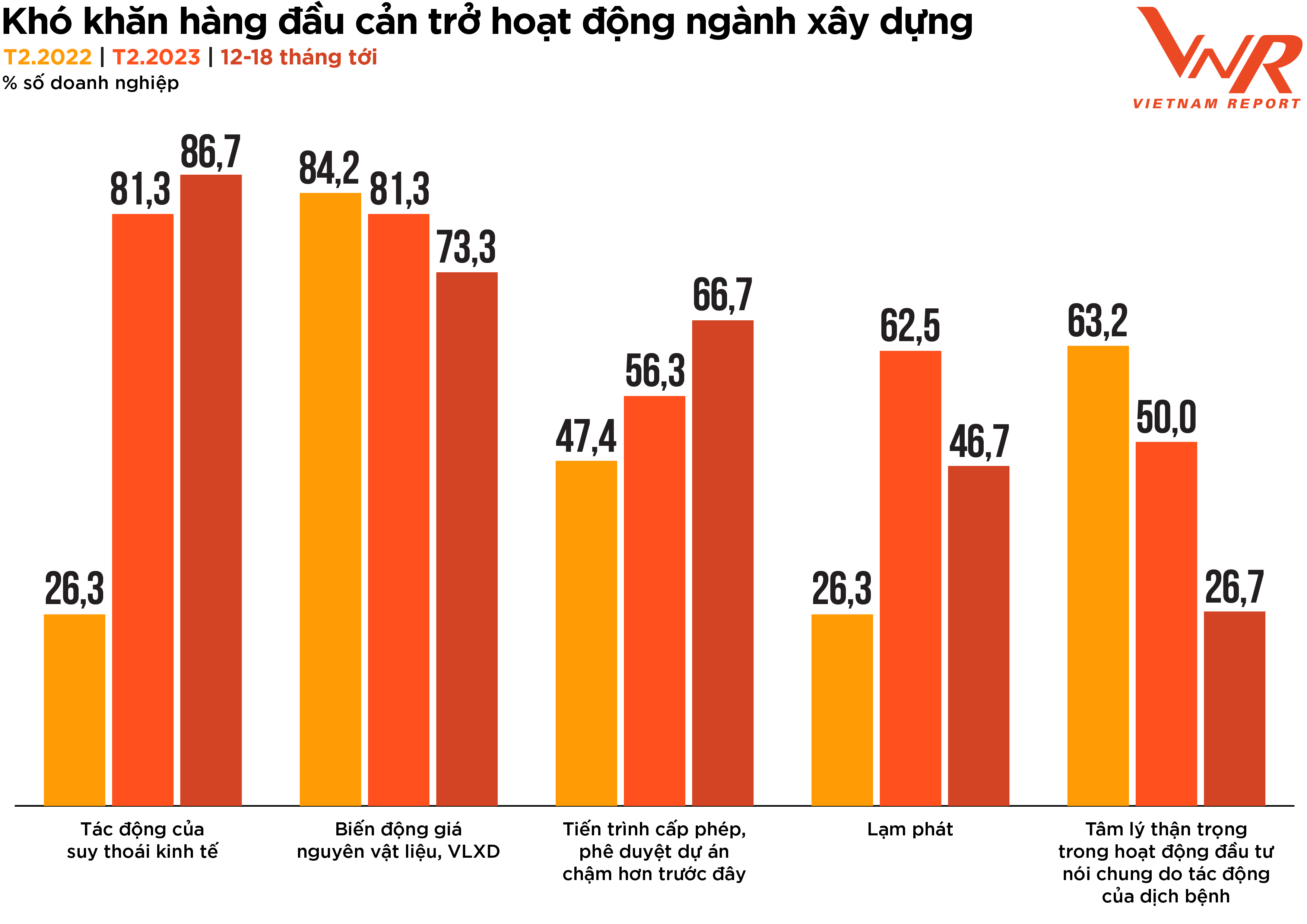
Assessing the investment and business environment of the construction industry, most enterprises maintain a more cautious attitude than the previous year and there is strong differentiation among sectors. While two-thirds of enterprises believe that energy and utilities construction has not had many clear changes compared to the previous year, residential construction and commercial construction are assessed by the majority of enterprises as not very positive when construction demand in this segment has not improved and competitive pressure has increased (Figure 6).
Figure 6: Construction enterprises’ assessment of the investment and business environment of the construction industry this year compared to last year

Positive signals this year come from the infrastructure construction and industrial construction segments. For the group of infrastructure construction enterprises (especially expressway projects), although still affected by high input costs because materials accounting for a large proportion of total costs such as embankment soil, leveling sand, etc. continue an upward price trend, they are expected to gain momentum from public investment. The period 2023-2024 is forecast to be the peak of public investment disbursement, bringing a large volume of work for infrastructure construction enterprises. In October 2022, the Ministry of Transport announced an additional investment of VND 71.7 trillion (USD 2.9 billion) into the 2021-2025 public investment plan to fund road construction. According to the General Statistics Office, in Q1/2023 the implemented investment capital of the state sector was estimated at VND 153 trillion, up 11.5% compared to the same period of the previous year. Public investment capital is forecast to be boosted in the coming time and may create recovery momentum for many enterprises.
According to the report from the Vietnam Association of Construction Contractors (VACC), construction industry enterprises in 2022 recorded a decrease in workload, except for industrial construction – accounting for 10% – which remained stable. In the picture of 2023, industrial construction will still be a bright segment supporting the growth of the entire industry, with 66.7% of enterprises placing their trust in a brighter outlook.
In the coming time, steel/sheet metal raw materials, which account for a high proportion in the cost structure of industrial construction, are gradually stabilizing; profit margins of enterprises in this field are expected to improve when contracts with suppliers are adjusted according to new unit prices. In addition, momentum comes from booming demand for factory construction and industrial park infrastructure. The global production network is still shifting, and in recent years, Vietnam has emerged as a leading destination for global companies to establish their industrial and manufacturing bases as many leading corporations affirm their commitment to invest more in our country.
Figure 7: Opportunities contributing to the growth of construction enterprises

Vietnam Report’s survey points out 6 opportunities promoting construction activities this year, including: (1) A workforce strong in expertise, rich in experience, and highly disciplined; (2) Position and competitive capacity; (3) The company’s vision and business strategy are clear and capture market trends; (4) Foreign direct investment (FDI) poured into Vietnam increases strongly; (5) High-quality products with competitive prices; and (6) Many legal difficulties and obstacles related to the real estate market have been and are being focused on being removed (Figure 7). Among them, the factor of a workforce strong in expertise, rich in experience, and highly disciplined is assessed as the most important driver for the industry’s growth momentum, and is also the factor with the highest increase in the proportion of enterprises selecting it compared to 2022 (+17.1%). With the characteristic of using a large amount of labor in the economy, the quality of human resources has decisive significance for the development and success of construction companies. Having a skilled workforce with high expertise is necessary to complete projects on time, within budget, and to required standards; thereby improving labor quality will directly affect construction enterprises’ productivity, efficiency, and profits.
Construction is inherently one of the industries attracting the most foreign direct investment (FDI) in recent years; therefore, two-thirds of construction enterprises continue to expect FDI to be a driving force supporting the overall development of the entire industry in the coming time. In mid-February 2023, the Foreign Investment Agency under the Ministry of Planning and Investment reported that Vietnam is capable of attracting VND 831.1 to 877.3 trillion (USD 36 to 38 billion) of FDI capital in 2023 – up from VND 287.7 trillion (USD 27.7 billion) in 2022, further strengthening growth confidence for construction enterprises amid surrounding difficulties.
Expectations of proactively breaking through, shaping the construction market in the new economic cycle
Looking back at the path that has been passed, it can be seen that shocks such as COVID-19, credit tightening, new manufacturing technology, or the digitalization process, new material technology… have been and are making the entire construction industry as well as each enterprise gradually “transform” with a completely new appearance, becoming stronger and more resilient. As an industry often in a passive position due to cash flow, supply, profits… depending heavily on partners, at the present stage construction industry enterprises are increasingly proactive in order to be able to save themselves and affirm their prestige with investors, customers, and related parties.
On a 5-point scale, enterprises in the industry evaluate the importance of building resilience when implementing projects and allocating their company’s capital at 4.5 points – meaning very important, increasing by 0.3 points compared to the previous year’s survey results.
Assessing the level of commitment to improving resilience of construction enterprises when implementing projects and allocating capital in the face of future disruptive events recorded a positive signal when there was a shift in the proportion of enterprises from the planning stage to being in the process of improvement and having completed (Figure 8).
Figure 8: Level of commitment to improving resilience in the face of future disruptions/shocks

Vietnam Report’s survey results indicate 7 priority solutions of construction enterprises in the short and medium term (Figure 9). Five of the seven priorities above are within efforts to improve enterprise resilience (risk management, financial management and human resources management).
Figure 9: Top 7 priority solutions of construction enterprises

Unable to be “securely well-off, with cash in hand” like other industries, in the construction industry, projects are often complex and involve many stakeholders. Planning, organizing, controlling and supervising the company’s financial resources to ensure that financial resources are allocated reasonably, projects are completed on time and within budget, and effectively managing cash flow throughout the project life cycle plays a decisive role in the success of enterprises. At the same time, effective risk management is also very important in the construction industry, where projects often face many risks, such as delays, design changes,… Effective risk management can help identify and mitigate these risks, reducing the possibility of delays, cost overruns and legal disputes. In the context of a tightening economy, liquidity in the real estate – construction market remains at a low level as it is currently, financial management and risk management capacity becomes the top priority of construction enterprises, with the expectation that it will help enterprises enhance competitiveness in the industry as well as enhance prestige with customers and investors, while better managing their resources, reducing waste and maximizing profits.
In addition, the solution of Strengthening investment cooperation was chosen by 46.7% of construction enterprises to remove current difficulties and promote development, and the number choosing this solution for the next 3 years recorded a significant increase (+14.9%). This is an important strategy for construction enterprises that want to grow and develop in an increasingly competitive market. Construction enterprises can attract more investors and partners, including private equity firms, venture capital investors and institutional investors. By leveraging the resources, expertise and capital of external partners, construction enterprises can expand scale, improve profitability and mitigate risks.
echnology-related solutions continue to be a priority for many construction enterprises. Multi-dimensional pressure forces enterprises to seek solutions to innovate operating methods to optimize costs & resources. Technological innovation to improve efficiency and increase work productivity is a trend that will become popular and develop strongly in 2023, with the top 5 technologies assessed by construction enterprises as having the potential to deliver the largest return on investment (ROI) including: Building information modeling (BIM), Use of advanced data analytics, Mobile platforms, Use of basic data analytics, Robotic process automation/digital labor. Most technologies have an increasing proportion of construction enterprises choosing them compared to the 2022 survey results. Among them, building information modeling (BIM) has the strongest upward trend (+81.4%). As a technology that creates and manages digital characteristics to optimize the stages of design, construction & operation of works, BIM has changed the way construction industry enterprises approach design, planning, building and maintenance. This technology will improve collaboration, efficiency, quality, sustainability and safety, leading to better project outcomes and improving competitiveness for construction enterprises.
From the beginning of the year up to now, many conferences have been organized with a series of support programs encouraging the Government’s development of the construction industry in 2023; public investment capital is forecast to be boosted in the coming time and positive signals from FDI may create recovery momentum for many enterprises. However, from forecast to reality is still not an overnight matter and not many enterprises have the proactiveness to seize opportunities in the market. Entering a new stage with many new challenges but also promising more opportunities. “Gold is tested by fire, strength is tested by hardship”; if overcoming the current stage when the market is filtering, reputable contractors with good resilience and strong financial capacity will have the opportunity to push profit growth to break through more than ever.
Vietnam Report


